Describe what happened. Get a claim ready to file.
Claim-Fi keeps a person’s insurance policies in one place. When something goes wrong, they tell it what happened in their own words. It picks the policy that applies, fills the insurer’s own claim form, and hands back a claim ready to file. Insurers that join see their claims, complete and in one format, in a single console. First line: motor. In development.
The flow
From what happened to a claim ready to file.
Steps
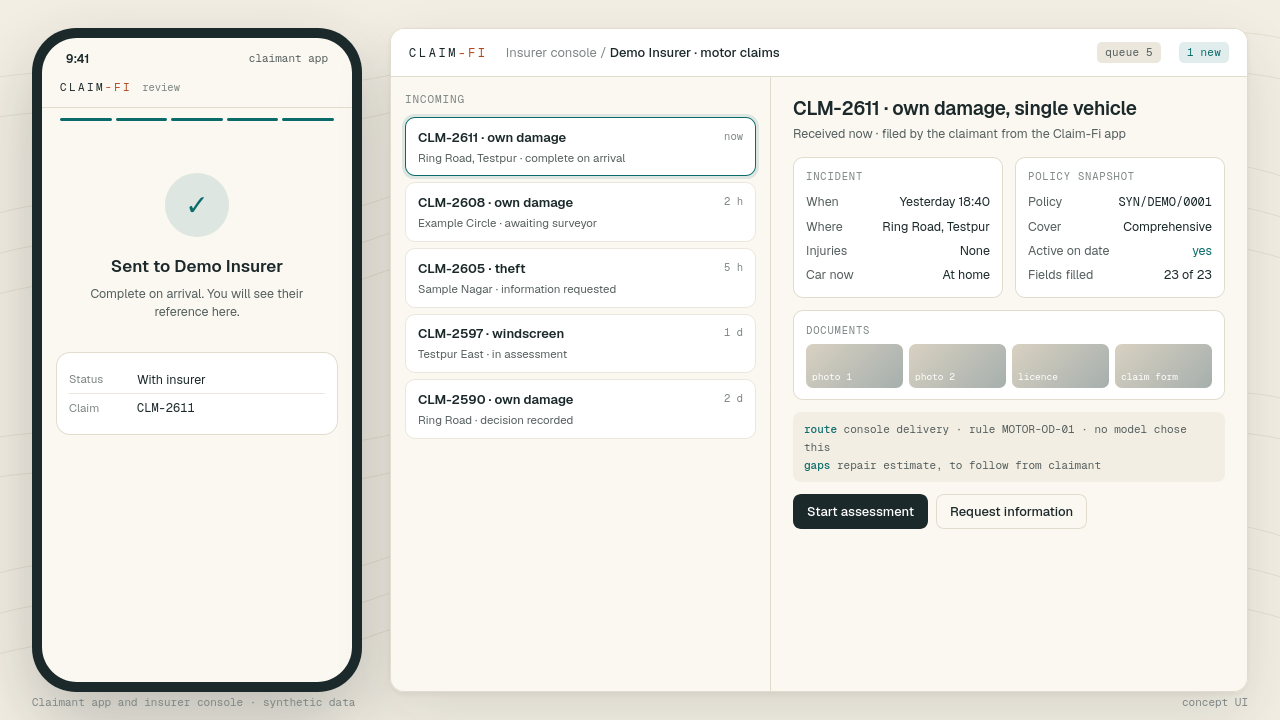
For insurers, claims handlers work from one console: a single queue, each claim with its data, documents and policy snapshot, and a way to ask the claimant for more.
Principles
What it will and won’t do.
| Principle | In practice |
|---|---|
| No invented facts | Every field carries its source: the claimant, their profile, the policy, a document or the device. Unknown values stay blank and flagged. The same discipline as Atlas. |
| The claimant confirms | Nothing is shared with an insurer without the claimant’s explicit confirmation. |
| Not the decision maker | It never says a claim will be approved or rejected. It can say what the policy wording appears to cover or exclude. |
| Honest reporting | It records what the claimant states, never suggests changing facts to strengthen a claim, and flags inconsistencies neutrally. |
| Deterministic routing | No model decides where a claim goes. The same claim and rules always give the same route, with the reason recorded. |
| Insurer rules as data | Forms, required documents and conditions live in versioned rules, so adding an insurer is a data change, not a code change. |
Let’s talk about your claims.
If you write or administer motor claims in India and want claims to arrive complete and in one format, we’d like to walk you through Claim-Fi and hear how your team handles claims today.
Email the team Goes to sales@craton-labs.com